

When starting a counted cross stitch project, choosing fabric count is crucial. It determines how many stitches fit in an inch. This affects the size, detail, and texture of your finished piece.
Different fabric counts, like Aida’s 14, 16, or 18, and higher evenweave or linen counts, change how patterns look. They also affect how shading blends.
The fabric count you pick also influences your choice of DMC floss strands, needle size, and stitching techniques. These choices together impact the clarity, outlining, and visual weight of your design. For instance, a 32-count linen stitched “over 2” looks different than 16-count Aida stitched with the same floss and pattern.
This guide will help you understand fabric count’s impact and how to choose the right fabric for your project. You’ll learn about testing fabrics, avoiding mistakes, and matching count to pattern complexity. This way, your finished piece will look exactly as you imagined.
Key Takeaways
- Fabric count controls stitches per inch and largely determines finished dimensions.
- Lower counts yield bolder, more textured results; higher counts allow finer detail.
- Your choice of floss strands, needle, and technique must match the fabric count.
- Test with a small swatch before committing to a large counted cross stitch project.
- Select count based on pattern complexity, framing plans, and your stitching comfort.
What fabric count means and how it affects stitch size
Fabric count is key to knowing how your design will look. It’s the number of holes or squares per inch. This number shows how many stitches fit in one inch, impacting your project’s size.
Definition of fabric count
When choosing cross stitch fabric, the count number is important. It tells you how many threads or squares are in each inch. For example, 14-count Aida means there are 14 stitches per inch.
Linen, on the other hand, uses higher counts but is stitched over multiple threads. This changes the actual stitches per inch.
How count determines finished dimensions
To find the finished size, divide the pattern’s stitch count by the fabric count. For instance, a 42 x 42 stitch motif on 14-count fabric is 3.0″ wide. On 16-count, it’s about 2.625″.
Higher counts mean smaller finished sizes, while lower counts result in larger pieces. This is why it’s crucial to adjust sizes when adapting patterns.
Many designers, like Stitched Modern and DMC, provide stitch counts. This lets you test sizes before starting a full project.
Difference between Aida, evenweave, and linen counts
Aida is great for beginners because of its clear square holes. It’s available in counts like 14, 16, and 18. The grid makes counting stitches easy.
Evenweave has tighter thread spacing, making it perfect for detailed patterns. It’s stitched over the exact number of threads for balanced Xs.
Linen has a textured surface, giving your work a refined look. Counts like 28, 32, or 36 are often used “over 2.” This means 28-count linen, worked over two threads, has 14 stitches per inch.
Practical tip: If you find unknown fabric, mark a one-inch span with pins or a ruler. Count the squares or threads to find the fabric count. This helps plan your floss, needle size, and project scale.
How fabric count influences stitch clarity, detail, and texture
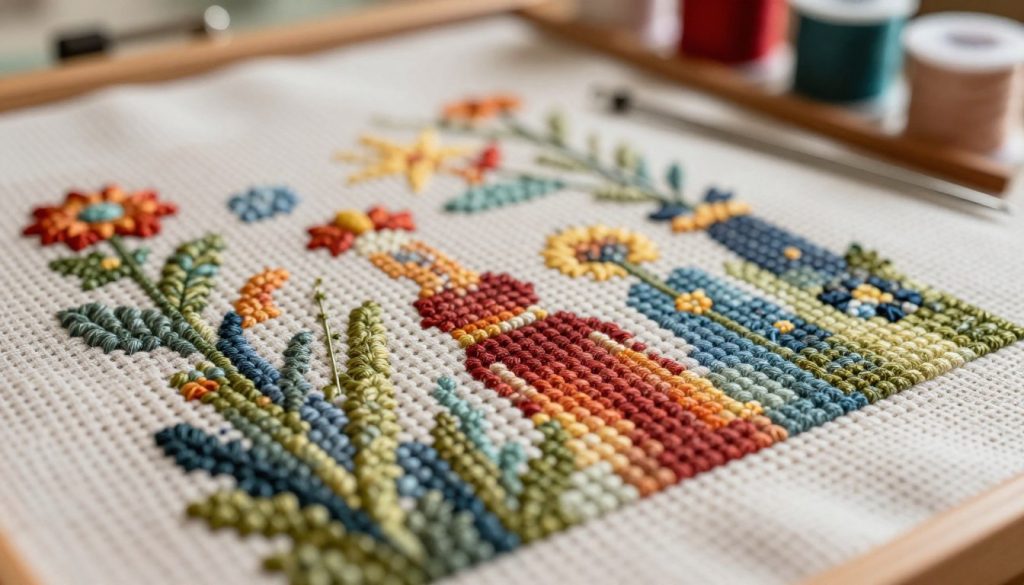
Choosing fabric count changes how your work looks at first glance. Higher counts mean more stitches per inch. This makes cross stitch details clearer and curves smoother.
If you’re working on portraits or detailed motifs, higher counts are key. They help capture small color changes and highlights.
Lower counts make each stitch bigger and bolder. This adds texture and a handmade look. It’s perfect for rustic or graphic designs.
You can finish big projects faster on 11- or 14-count Aida. The surface is tactile and draws the eye.
Backstitching techniques need to change with your fabric choice. On high-count linens, a single strand of DMC works well. It gives crisp, delicate outlines without overpowering the cross stitch.
For mid-range counts, two strands usually work best. They offer balanced contrast without filling in areas.
On low-count fabric, you might need thicker lines for outlines. Use multiple strands or a heavier color to keep outlines clear. Always test backstitching techniques on a swatch first.
Think of fabric count as a tool for style and detail. Use higher counts for precise details and subtle shading. Choose lower counts for bold texture and strong designs.
CROSS STITCH: choosing the right count for your project
Choosing the right fabric count changes how your cross stitch looks and feels. Think about the pattern, the size you want, and your comfort with detail. This guide helps you pick the right fabric for your project.
Match the count to your pattern complexity
For detailed patterns like portraits or intricate florals, use 16-count or 18-count Aida or high-count evenweave or linen. These counts help you capture small details clearly. For simpler patterns, 14-count or lower is better for bold, graphic designs.
Consider finished size and framing
Calculate the finished size of your project before buying fabric. Divide the stitch count by the fabric count to get the inches. Add margins for frames and matting. If using a wooden hoop, add extra fabric for stretching.
Account for your skill level and comfort
Beginners often prefer 14-count Aida for its large holes and quick stitches. If you have good eyesight and patience, try tighter fabrics for finer details. Higher counts mean more detail but take longer and require consistent tension.
Practical swaps and stylistic tips
- Want linen texture with bigger stitches? Choose a lower-count linen or stitch evenweave over 1 instead of over 2.
- If a pattern is labeled for 14-count but you prefer a smaller finished piece, move to 18-count and recalculate — this preserves the design while shrinking dimensions.
- Test one small motif to confirm how a count affects color blending and backstitching before committing to a full project.
These tips will help you enjoy your cross stitch projects. They ensure your work fits your chosen frames and meets your style.
Floss, needle size, and technique adjustments by fabric count
Adjusting floss, needles, and techniques can improve your stitching. Small changes help keep stitches even and protect details. Choose practical options that fit the fabric and your design.
How many strands of DMC floss to use
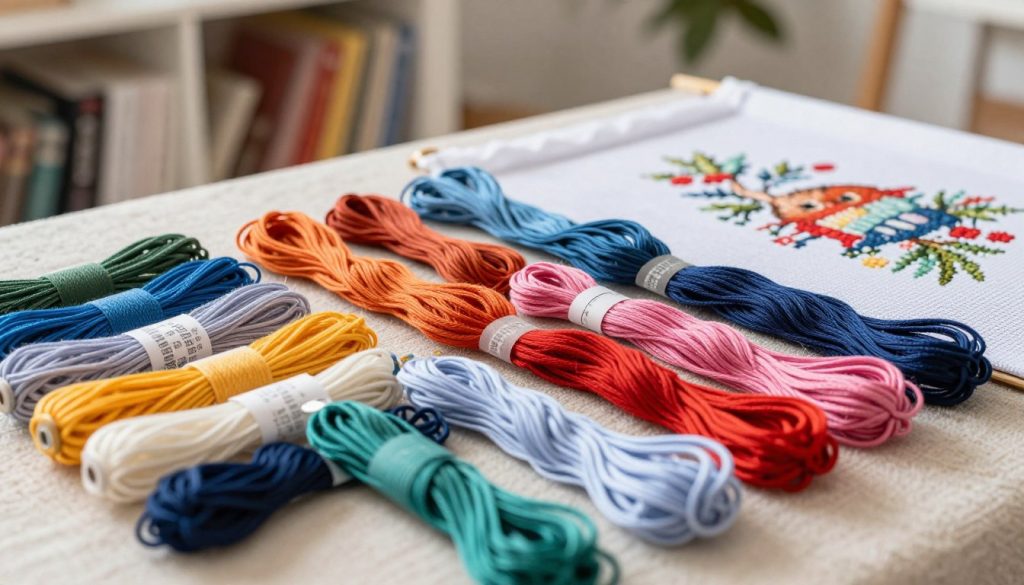
For 14–16 count Aida, use two strands of DMC floss for balanced coverage. On 18 count and finer, switch to one strand or use two thin strands. This avoids bulky stitches and preserves detail.
On low counts like 8–11, use three or more strands for a bold, textured look. Variegated DMC floss works best with two strands to keep color shifts clear.
Needle selection and ergonomics
Choose a needle that fits the fabric and strand count. Lower-count fabrics need larger needles for easy movement. High-count fabrics require finer needles, often #24–28.
Consider ergonomics for long stitching sessions. Ergonomic needles or larger-eyed needles reduce finger strain with multiple strands. A magnifier or bright light helps with fine counts to prevent eye fatigue.
Stitching techniques and tools to adapt
Grid large or high-count projects with water-soluble pens or tacking thread. This cuts mistakes and keeps details sharp. Use Q-snap frames or scroll frames for even tension on fine fabrics.
Use tools like thread conditioners to smooth your workflow. Adjust backstitch strand count for crisp outlines. Switch needle selection for outlining to match strand thickness.
Organize your workspace for better efficiency. Good organization—labeled bobbins, a needle case, and a tidy thread map—keeps supplies ready. Adopt techniques that match the fabric for neat, accurate, and enjoyable stitching.
Practical testing: sampling, swapping fabrics, and troubleshooting mistakes
Before cutting a big piece of fabric, do a quick test. A small trial helps you see how well it covers, how colors shift, and how backstitching looks. This step saves time and avoids expensive mistakes later.
Make a swatch of the most detailed part of your pattern. Use the same DMC strands and needle as planned. Stitch over a 30 by 30 block if you can. Check if the stitches are dense, the texture is right, and backstitch outlines are sharp.
To swap fabric without changing size, convert stitch counts to inches. Divide total stitches by fabric count for inches. For example, 200 stitches ÷ 14 = 14.3 inches on 14-count Aida. To keep the same size on linen, stitch over 2 on 28-count linen.
When swapping fabric, adjust floss strands and needle size to match. A linen or evenweave might need fewer strands to avoid bulky stitches. Test these changes on your swatch.
Common mistakes often show up in the swatch. Too many strands on high-count fabric can make stitches bulky and messy. Choosing a high count for a beginner can cause tension and frustration.
Always recalculate finished size when changing fabric counts. Miscalculations can lead to framing issues and altered proportions. Use a grid for large, high-count projects to avoid counting errors and reduce rework.
Backstitch visibility depends on strand thickness and fabric count. Try different thread weights on your sample before committing. This quick test solves many cross stitch problems without wasting hours on the main piece.
- Stitch a focused swatch to evaluate coverage and backstitch clarity.
- Convert stitches ÷ fabric count when you swap fabric to keep the same finished inches.
- Adjust floss strands and needle size after cross stitch testing to match visual weight.
- Grid high-count projects to prevent counting errors and reduce rework.
Creative uses and project ideas based on fabric count
Fabric count affects how your project looks and feels. Lower counts make bold textures that stand out from afar. Higher counts allow for detailed shading and small details for close-up views. Mixing counts can guide the eye, highlight a focal point, or speed up a large area.
Best picks for lower counts
For big home decor, use 6–14 count fabrics. They’re great for cushions, wall hangings, holiday stockings, and folk-art samplers. These projects are perfect for beginners or those who stitch for relaxation. They’re quick to finish, keeping your creative flow going.
Best picks for higher counts
Go for 16–18 count or 28/32 evenweave for detailed work. This is ideal for portraits, miniatures, botanical studies, and detailed wildlife scenes. Use DMC floss for subtle shading and color transitions to create framed art. These counts are favored by those who aim for gallery-quality pieces.
Combining counts within one project
Layer fabrics to highlight certain areas. Stitch faces or lettering on high-count linen inside a lower-count Aida border. Plan seams and transitions for a cohesive look. Swatch junctions and keep strand counts the same for a unified piece.
Try variegated DMC floss and adjust strands for texture across counts. Draft a mock layout and test proportions for projects mixing scales. These experiments lead to new ideas and patterns, keeping your work engaging and therapeutic.
Conclusion
Fabric count is key to your cross stitch piece. It affects stitch size, texture, and more. It also guides choices on floss, needles, and framing.
Use the formula stitch-count ÷ fabric-count to guess sizes. This helps keep your work consistent with patterns.
Before starting, measure fabrics with a pin-and-count method. Make small swatches to test floss, needles, and backstitching. Start with 14-count Aida for beginners. Then, move to 28-count linen as you get better.
For big projects, use gridding and the right tools. A hoop or frame and ergonomic tools like magnifiers help. These tips make your work easier and look better.
Remember these tips: test fabric, swatch floss and needles, and match fabric count to pattern complexity. Use the right tools. Good fabric choices make your work clearer and more detailed.
FAQ
What is fabric count and how does it affect stitch size?
How do I calculate the finished size of my cross stitch piece?
What’s the difference between Aida, evenweave, and linen counts?
How does fabric count change stitch clarity and detail?
Why do lower-count fabrics look bolder and more textured?
How does fabric count affect backstitching and outlining?
How do I choose the right count for my pattern complexity?
How should I factor finished size and framing into my fabric choice?
Should I choose fabric count based on my skill level and eyesight?
How many strands of DMC floss should I use for different fabric counts?
What needles and ergonomics match different fabric counts?
What stitching techniques and tools should I adapt by fabric count?
Should I make a swatch before starting my main project?
How can I swap fabric types without changing my finished size?
What common mistakes involve fabric count and how do I avoid them?
What projects are best suited to lower fabric counts?
What projects benefit from higher fabric counts?
Can I combine different fabric counts in one project?
Any creative tips for using count to emphasize focal points?
How do I measure an unknown fabric’s count?
What tools help maintain accuracy and reduce eye strain on fine counts?
This post contains affiliate links. If you click on a link and make a purchase, I may earn a small commission — at no extra cost to you. Thank you for supporting this blog and helping me keep the patterns free! Read the full Affiliate Disclosure & Transparency.