
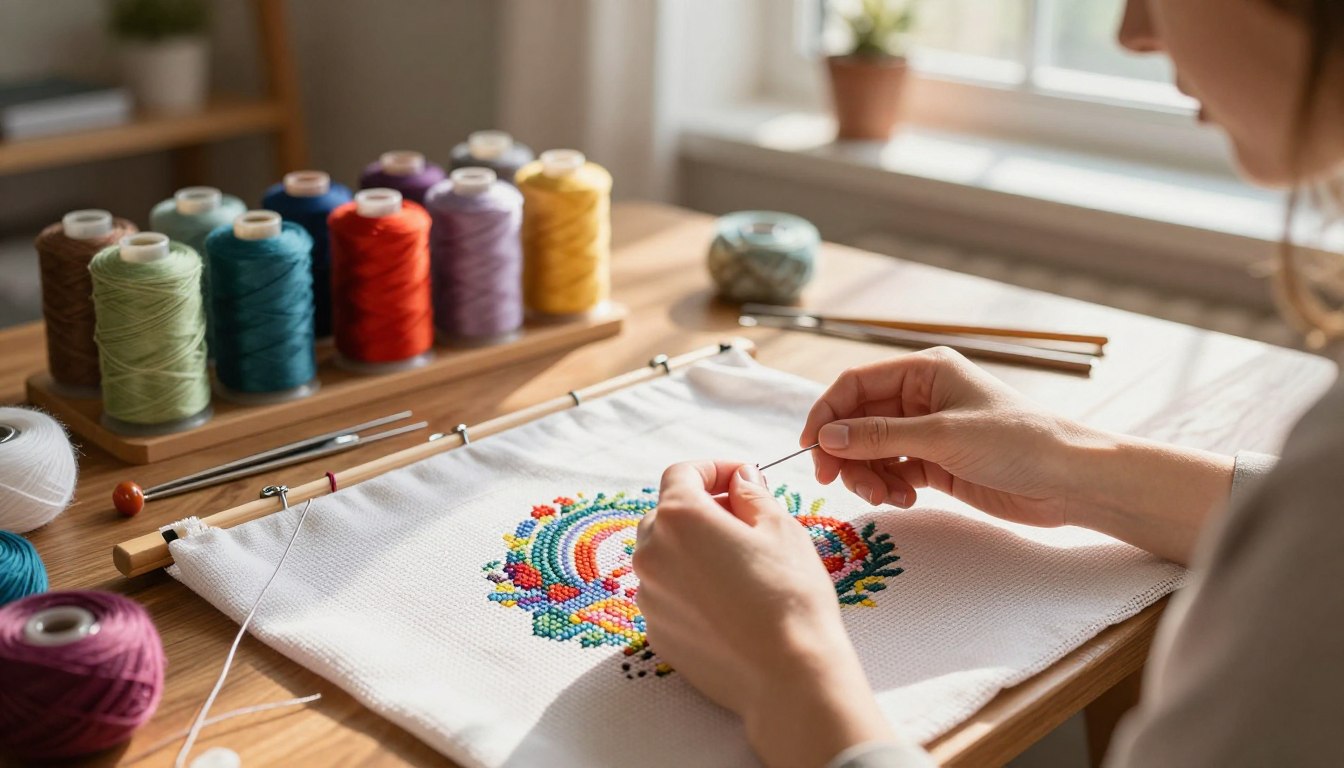
Slow stitching changes how you approach CROSS STITCH. It’s about being mindful and intentional with every stitch. It’s not about how fast you can sew, but about the journey.
By slowing down, you focus more on each stitch. You notice how the thread behaves and adjust it as needed. This approach, as writers like Claire Wellesley-Smith point out, makes you a better maker while reducing stress.
Working slowly makes your embroidery more precise. You make fewer mistakes and keep your stitches even. This is crucial for the look and feel of your work.
Slow stitching also has mental health benefits. It can lower stress and improve your mood. It helps you enjoy the process more, making you want to keep stitching.
It’s also good for the planet. Using fabric scraps or old clothes is part of the slow-stitch movement. It makes your projects both beautiful and eco-friendly.
This guide is for makers in the United States. It offers practical tips and techniques to improve your craft and wellbeing. You’ll find ideas to enhance your stitching experience.
Key Takeaways
- Slow stitching means mindful, intentional hand sewing that values process over speed.
- Working slowly improves stitch quality, tension control, and reduces common cross stitch mistakes.
- Mindful embroidery boosts mood and lowers stress while promoting focus and flow.
- Practical techniques—gridding, frames, and proper DMC floss handling—support better results.
- Using scraps and repurposed textiles ties cross stitch practice to sustainability and slow-fashion values.
How slow stitching improves precision and stitch quality for cross stitch techniques
When you slow down, each stitch becomes deliberate. This pace helps you spot common cross stitch mistakes early. You catch tangled threads before they knot and notice misplaced color changes.
Use short lengths of floss and check grid reference points often. Count deliberately rather than racing through long runs. Simple checks after each block or motif keep errors small and reduce the need to frog work later.
Better tension control starts with awareness. Uneven tension will distort the fabric weave and skew counted cross stitch patterns. Working slowly lets you feel the pull of each stitch and make tiny adjustments as you go.
Test tension on a swatch before you begin a big piece. Use even-length floss segments and re-evaluate after a few rows. This practice yields accurate stitch placement, smoother surfaces, and consistent coverage that make framing and finishing less stressful.
Finishing demands focus. Backstitching techniques and outlines need consistent stitch length and alignment to look crisp. Rushing produces wobbly lines and misaligned intersections with the crosses beneath.
Take your time on backstitching, beads, and specialty stitches. Secure thread ends neatly, trim carefully, and press or block with intention. Those small acts of care reveal needlework secrets that turn a good piece into a polished one.
| Common Issue | What Causes It | Slow-Stitch Fix |
|---|---|---|
| Miscounting | Rushing across large areas without checks | Count deliberately, mark grid points, check after each block |
| Skipped or extra stitches | Loss of focus during long stitching runs | Use short floss lengths and pause every few rows |
| Inconsistent X direction | Speed causes reversed crosses | Establish a routine for your stitch direction and slow the rhythm |
| Tangled threads | Too-long floss and hurried handling | Cut shorter strands and untwist frequently |
| Misplaced color changes | Skipping color reference checks when moving areas | Double-check pattern legend and color at each transition |
| Uneven tension | Inconsistent pulling while stitching fast | Practice on a swatch, maintain even-length segments, adjust per stitch |
| Wobbly outlines | Hurrying backstitching at the end | Slow backstitching techniques, keep stitch length uniform, check intersections |
Mental health and wellbeing benefits of slow stitching and embroidery therapy
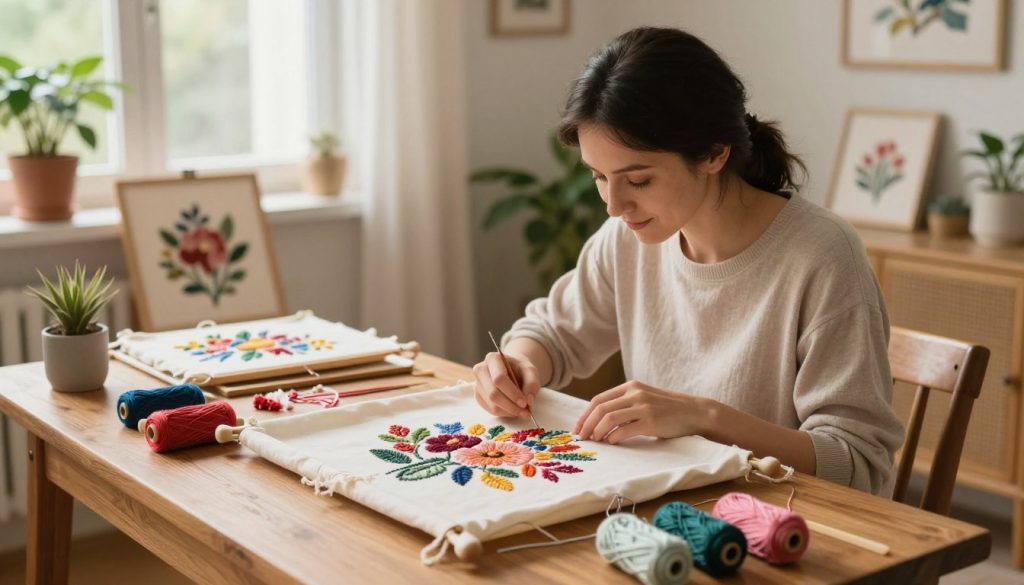
Slow stitching has clear mental health benefits you can feel right away. Studies in the Journal of Occupational Therapy International and Arts in Psychotherapy show it lowers anxiety and stress. It also improves your mood by calming your nervous system through repetitive motion.
Think of cross stitch and embroidery as easy mindfulness practices. Doing the same stitches over and over creates a calming rhythm. This quiets your mind and helps you focus on the task at hand, as writers like Rachael Matthews and Claire Wellesley-Smith explain.
Practical benefits of emotional well-being appear quickly. Completing small cross stitch projects boosts your confidence and self-esteem. People in occupational therapy studies say they feel more emotionally stable and less stressed after stitching regularly.
Textile work has been a comfort in tough times for a long time. Historical examples show how embroidery brings structure and purpose during hard times. Today, therapists use sewing to help people with depression and anxiety, as it can be adjusted to fit their energy levels.
You don’t need to be skilled to benefit from this practice. Even simple stitches like the backstitch or running stitch can be therapeutic. Start with small projects and make time for stitching as a way to care for yourself. Joining a stitching group adds social support and motivation as you work on projects together.
Sensory and flow advantages that lead to consistent results
When you slow down, your stitching becomes a rhythm. This rhythm helps you enter a flow state, where time seems to disappear and focus becomes sharper. Studies show that making art can lower cortisol levels, leading to a calm and focused state.
Touch, sight, and sound help keep you grounded while stitching. The feel of fabric under your fingers guides your needle. Colors on the fabric give you a visual reward and show your progress. The sound of thread moving through fabric sets a soothing pace, helping you stay focused.
Occupational therapists suggest tactile activities for emotional balance. Cross stitch can be a tool for this. Try short sessions and track how you feel. Simple tricks like changing thread textures or using a wrist rest can keep you comfortable and focused.
Finding the right challenge is key. Tasks should be engaging but not overwhelming. If a project is too easy, you might get bored. If it’s too hard, mistakes increase and progress slows.
Adjust the challenge as needed. Break big projects into smaller parts or add gridding. Good organization helps you switch tasks smoothly, keeping you in the right flow.
| Aspect | Practical Move | Benefit |
|---|---|---|
| Flow state | Work 25–45 minute focused intervals with short breaks | Deep focus, reduced cortisol, more consistent stitching |
| Sensory grounding | Choose fabrics and floss with distinct textures and colors | Better attention, mood regulation, less drift |
| Goldilocks challenge | Match pattern complexity to skill; split large projects | Maintains engagement, reduces errors, improves learning |
| Cross stitch organization | Label threads, use bobbins, grid fabric before starting | Saves time, prevents mistakes, eases transitions between sessions |
| Cross stitch therapy | Schedule regular stitching as part of self-care | Emotional stability, improved sleep, steady progress |
| Cross stitch tips | Work from center, maintain consistent tension, check light source | Cleaner stitches, fewer reworks, more pleasing finishes |
CROSS STITCH: Why slowing down matters for counted cross stitch projects
Slowing down in counted cross stitch makes your stitches more accurate. This careful approach helps avoid mistakes in symbol reading and color changes. It saves time and keeps your focus on the design.
Choosing the right fabric is key. Aida has clear holes, evenweave offers a finer texture, and linen adjusts with tension. Slow, steady stitches prevent distortion on linen and evenweave, while Aida’s grid stays intact.
For big projects, create a routine. Grid your fabric, mark key points, and work in sections like 10×10 squares. A magnifier or strong light helps with eye comfort and keeping count during color changes.
Small habits make a big difference. Keep threads neat, floss untwisted, and avoid long backstitch runs. Stitching in short sessions helps maintain even tension and consistent crosses.
Slowing down improves color blending and backstitch placement. This careful pace ensures smooth transitions between shades and accurate outlines. It makes finishing and framing easier and more professional.
Before starting, remember these tips:
- Grid fabric and mark center points
- Check chart symbols and color key
- Set lighting and magnification
- Stitch in 10×10 blocks
- Review tension every 50–100 stitches
| Task | Why it helps | Result on cross stitch projects |
|---|---|---|
| Grid fabric before you start | Makes counting faster and reduces misplacement | Fewer corrections, accurate pattern placement |
| Use appropriate cross stitch fabric | Aida, evenweave, linen each respond differently to tension | Prevents distortion, improves final drape and framing |
| Work in 10×10 blocks | Keeps errors localized and easier to fix | Cleaner motifs and consistent stitch direction |
| Maintain lighting and magnification | Reduces eye strain and miscounts | Smoother color changes in complex cross stitch patterns |
| Check tension frequently | Ensures even crosses and flat fabric | Professional finish ready for backing or framing |
Practical slow-stitching techniques, tools, and embroidery hacks
Slow stitching begins with the right tools and habits. Choose gear that encourages careful work. Small changes in your routine can make your stitches neater and keep your pace steady.
Essential cross stitch tools and fabric choices
Start with a basic kit: blunt tapestry needles, quality DMC floss, sharp scissors, a needle threader, and a bright lamp. These tools help you focus on each stitch without distractions.
Choose fabric based on your skill level. Aida is great for beginners with its clear grid. For advanced stitchers, evenweave and linen offer more detail. Always match your needle size to the fabric count for smooth stitching.
Gridding, frames, and organization to slow your workflow intentionally
Break your work into smaller blocks. Use markers or pre-printed grids to guide you. This method reduces mistakes and helps you work steadily.
Frames like Q-snaps or embroidery frames keep your fabric flat. They help you focus on one area at a time. This focus helps slow you down.
Keep your floss and patterns organized. Use bobbin cards or a floss organizer, label your colors, and wind short lengths. Store your projects in bags so you can pick up where you left off easily.
DMC floss handling, needle selection, and needlework secrets for neater stitches
Handle your thread carefully. Separate strands before threading to avoid twist. Always cross in the same direction for uniform texture. Use loop starts for short threads and secure away starts for longer ones.
Choose blunt tapestry needles to prevent fabric damage. Match your needle size to the fabric count for easier stitching. The right needle makes a big difference in your work.
Simple habits can make a big difference. Work in blocks, count twice, bury tails neatly, and press your work before framing. These habits lead to professional-looking results.
| Task | Recommended Tool or Method | Benefit for Slow Stitching |
|---|---|---|
| Thread preparation | Separate strands; use DMC floss | Less twist, consistent tension, smoother stitches |
| Fabric choice | Aida for beginners; evenweave/linen for advanced | Clear guides for counting; finer detail and control |
| Gridding | Water-soluble pen, basting thread, pre-printed grids | Fewer counting errors; measured, deliberate progress |
| Hooping and support | Embroidery frame or Q-snap | Flat fabric, reduced distortion, focused work area |
| Length of floss | 12–18 inch cuts | Fewer tangles, easier tension control |
| Needle choice | Blunt tapestry needles sized to fabric count | Avoids splitting threads and fabric, smoother passage |
| Finishing tip | Bury tails neatly; press gently before framing | Cleaner back, aligned stitches, better presentation |
Creative benefits: better design choices, cross stitch patterns, and unique cross stitch ideas
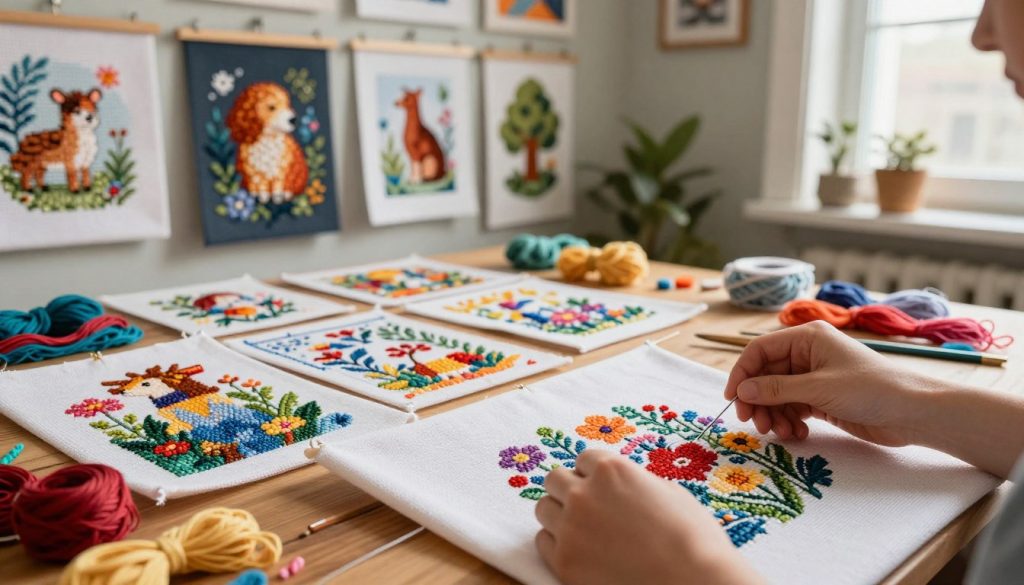
When you slow down, you notice colors you might have missed before. You get to play with colors and adjust patterns for any room or gift. Small moments let you change a single thread or try new shades for depth.
Slow stitching lets you play with texture too. You can add special stitches or layers to make your work stand out. Mixing different techniques turns simple ideas into something special.
By slowing down, you can change your designs without worry. You can adjust shapes, add new details, or change borders. These changes make your work feel truly yours.
Using eco-friendly materials can also inspire you. You can use old fabrics or clothes to create something new. This way, you make something useful and spark new ideas.
Try short projects to find your style. Small pieces can teach you about colors and shapes. Doing these slowly helps you find what makes your work unique.
Working slowly lets you take risks in a safe way. You can try new things and see what works. This approach leads to more creative and meaningful work.
| Creative Direction | Slow-Stitch Benefit | Practical Prompt |
|---|---|---|
| Personalized palettes | Better color harmony through testing and small tweaks | Create three 4×4″ swatches using tonal shifts of one color |
| Textural mixing | Enhanced surface interest by combining stitches | Add fractional stitches and two rows of French knots to a floral motif |
| Mixed-media upcycling | Sustainable, unique textiles that add story and depth | Embellish a denim pocket with a seasonal motif and backstitch initials |
| Detail-focused edits | Sharper outlines and refined motifs via careful backstitching | Redesign a sampler border using three backstitch variations |
| Sampler experiments | Rapid skill growth through short, deliberate projects | Stitch a 6×6″ sampler exploring two specialty threads |
How slow stitching supports learning, confidence, and community for beginners
Slow stitching lets you learn at your own pace. You’ll see your skills improve with each stitch. This method makes starting out less stressful and more fulfilling.
Begin with simple patterns
Start with Aida fabric and a few colors for your first projects. Begin with small samplers or patterns that teach you the basics. These steps are crucial before moving on to more complex stitches.
Find community and classes
Look for local quilt guilds, needlework groups, or online forums. These places are great for getting tips and support. Classes at craft stores or community centers offer hands-on learning and feedback.
Build skills through progressive projects
Start with simple projects like bookmarks or ornaments. Then, move on to framed samplers and cushion covers. Each success boosts your confidence and makes bigger projects seem doable. Your finished pieces can become gifts or donations, connecting you to the cross stitch community.
| Stage | Project Type | Skills Practiced | Why it helps |
|---|---|---|---|
| Beginner | Bookmarks, small motifs | Running stitch, half crosses, color counting | Quick completion builds confidence and reinforces basics |
| Intermediate | Small samplers, hoop art | Full crosses, simple backstitch, basic shading | Longer attention span and pattern reading improve technique |
| Advanced | Cushion covers, framed pieces | Complex charts, blending threads, neat finishing | Combines precision with design choices for polished results |
| Collaborative | Charity quilts, group pieces | Consistency, teamwork, large-counted cross stitch projects | Shared goals sustain motivation and deepen community ties |
Conclusion
Slow stitching teaches us that quality is more important than speed in CROSS STITCH. By taking our time, we make fewer mistakes and keep our stitches even. This leads to cleaner backstitching.
These improvements come from simple habits. Using DMC floss, the right needles, frames, and fabric with a grid helps a lot. These tips and tricks help you make your work neater and more reliable.
Slow stitching also lowers stress and makes you feel more in the moment. Using mindful techniques like short floss lengths and pacing your work improves your mood and focus. Organizing your tools and choosing patterns that fit your skill level makes learning easier and boosts your confidence.
Begin with a small project, like a sampler, to practice these tips. Or join a stitching group online or locally to get feedback and support. View stitching as a way to relax and express your creativity, not a race. By following these suggestions, you’ll likely see better results in your next CROSS STITCH project.
FAQ
Why does slowing down improve my cross stitch results?
What exactly is slow stitching?
What common cross stitch mistakes will I avoid by slowing down?
How does slow stitching improve my tension control?
Why is taking time important for backstitching and finishing?
Are there proven mental health benefits to slow stitching?
How does repetitive stitching create a flow state and lower stress?
What sensory benefits support slow stitching as grounding practice?
What is the Goldilocks challenge and how does it help me stay present?
Why does slowing down matter specifically for counted cross stitch?
Which fabrics are best for slow counted work and why?
What practical routines help me slow down productively on counted projects?
What essential cross stitch tools should I use to support slow stitching?
How should I handle DMC floss and choose needles for neater stitches?
What gridding and organization methods help me slow my workflow?
How does slowing down improve my design decisions and creative outcomes?
What beginner projects are best to practice slow stitching?
How can community and classes support mindful stitching?
What project progression builds skills and self-esteem?
Are there sustainability benefits to slow stitching?
How do I start applying these slow-stitch tips right away?
This post contains affiliate links. If you click on a link and make a purchase, I may earn a small commission — at no extra cost to you. Thank you for supporting this blog and helping me keep the patterns free! Read the full Affiliate Disclosure & Transparency.