
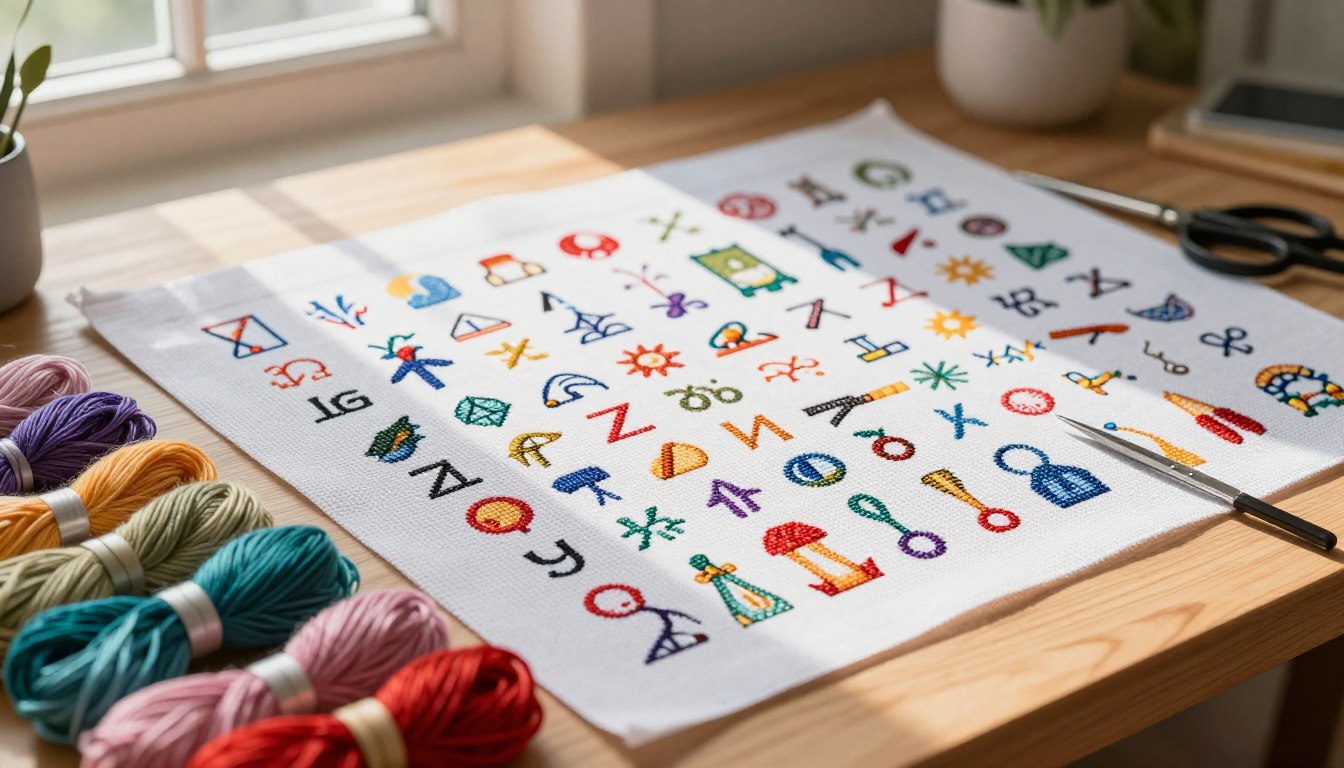
The symbol chart is your guide when starting a counted cross stitch project. Each square on the chart represents one stitch on your fabric. Reading it carefully helps avoid mistakes and saves time.
Charts detail where to place stitches, including full crosses, backstitch, and French knots. They also show stitch counts and finished dimensions for different fabric counts.
Professional charts come with a legend or color key. This links symbols to thread brands like DMC. They also include pattern notes on fabric count and strand usage, and copyright details to respect.
For beginners, the legend is crucial. It tells you which floss number and how many strands to use for each symbol.
It’s wise to start in the middle of the pattern. Charts mark the center with arrows on the top and side. This helps you align your fabric. For small patterns, you can find the center by eye. For larger pieces, use a ruler to mark the midpoint.
Always keep the chart oriented the same way as your fabric. Avoid rotating the pattern or fabric 90 degrees. This can change the stitch direction and affect the final look.
Key Takeaways
- Each chart square equals one stitch in counted cross stitch.
- Legends link symbols to floss numbers like DMC and recommended strand counts.
- Start in the middle using center arrows to align fabric and pattern.
- Respect copyright and do not copy or distribute charts without permission.
- Keep chart orientation consistent to preserve stitch direction and appearance.
Why symbol charts matter for CROSS STITCH
Symbol charts are key for any counted cross stitch project. They turn a design into step-by-step instructions. This way, you can stitch color, shape, and texture accurately.
Good charts save time and cut down on mistakes. They help you follow patterns on Aida, linen, or evenweave fabrics.
How charts translate design into stitches
A chart is a grid filled with symbols or color blocks. Each symbol points to a thread color in the legend, often with DMC numbers. By following the chart, you match the floss to the fabric square.
This direct mapping turns artwork into a stitched image you can reproduce reliably.
Why each grid square equals one stitch
The grid mirrors the fabric’s weave. On Aida, one square usually matches one fabric hole or weave intersection. This makes counting easier and ensures accurate stitch placement.
How center marks and grid lines help you start in the middle
Charts often show center arrows on the top and side that meet at the pattern center. Starting here keeps your design centered and ensures the correct size. Larger charts have darker 10-by-10 block lines for easier counting.
Common chart elements: legend, color key, and notes
The legend pairs symbols with thread colors and may suggest brand substitutions or strand counts. Backstitches are shown as lines and French knots as dots. Notes explain fabric count, floss brands like DMC, and special techniques.
Clear legend entries help with organization and avoid confusion.
Use these tips to set up your work: check the legend before starting, mark the center on both chart and fabric, and use light cross stitch gridding. These steps improve accuracy and make larger patterns easier to tackle.
Reading the chart grid and finding your place
Start by scanning the printed grid to get an overall sense of the design. You will see heavier lines every ten squares. These 10-by-10 darker grid blocks make counting easy for large patterns.
Line numbers at the margins pair with those blocks to point you to exact stitch coordinates.
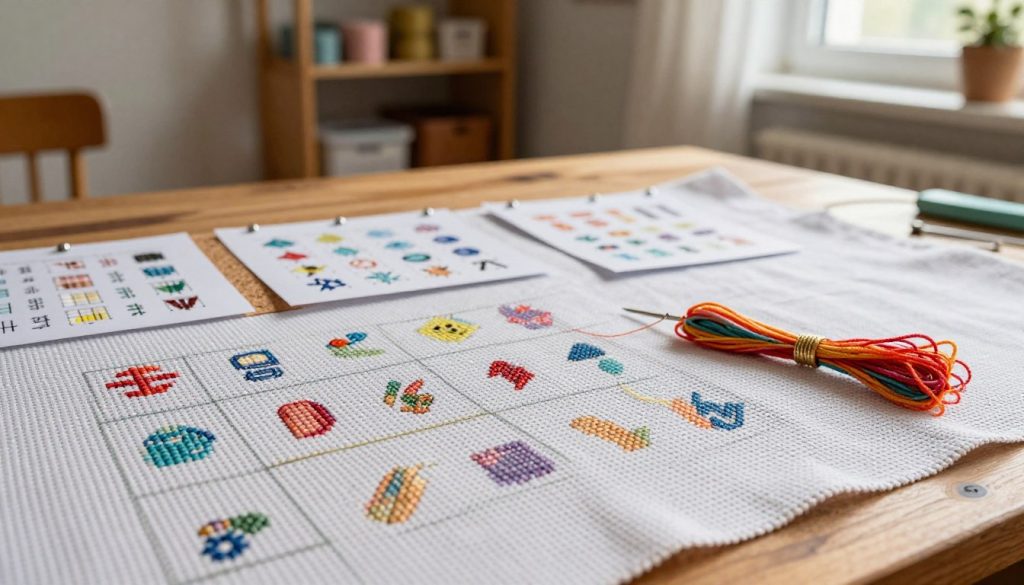
Understanding 10-by-10 darker grid blocks and line numbers
Each heavier line outlines a block of 10 by 10 stitches. Use these blocks as quick landmarks to avoid common mistakes like miscounting rows. When you read a row or column number, match it to the adjacent darker block and you’ll find the right square fast.
Marking progress along numbered rows helps when you pause and return. If you need to correct an error, the numbers let you communicate exact coordinates to a stitching friend or to your notes for cross stitch organization.
Using center arrows to align fabric and pattern
Look for small arrows on the top and side of the chart. Where they meet is the pattern center. Use a ruler to transfer that point to your fabric and mark it with a removable pen. Starting from the center keeps motifs balanced and prevents placement errors that plague many beginner cross stitch projects.
For counted cross stitch, aligning centers reduces the risk of running out of margin or shifting a motif off-center during framing. If you plan to grid your fabric, begin by matching the fabric grid to the chart’s 10×10 blocks.
Tips to avoid rotating charts or fabric incorrectly
Never rotate the pattern or fabric by 90 degrees relative to one another. Turning either can reverse the slope of your crosses. That change leads to mismatched stitch direction and visible inconsistencies in backstitch or specialty stitches.
Keep the chart orientation consistent with your working position. If you prefer the chart upside-down while stitching, maintain that orientation for the fabric too. Use light washable marks, a magnetic board, or clips to hold your chart steady to avoid accidental rotation during long sessions.
| Problem | Cause | Quick Fix |
|---|---|---|
| Miscounted row | Skipping a 10×10 block boundary | Refer to line numbers, count back to last dark line, correct stitches |
| Off-center project | Starting away from pattern center | Use center arrows, mark fabric center, begin stitching there |
| Inconsistent stitch slant | Chart or fabric rotated 90° | Reorient chart and fabric to match; restitch affected crosses |
| Lost place on large chart | No gridding on fabric | Apply cross stitch gridding to fabric or use a soft ruler to mark blocks |
| Slow progress tracking | No recorded line numbers or marks | Shade completed 10×10 blocks, log rows with pencil for cross stitch organization |
Decoding symbols, legends, and color keys
The legend in a chart is like a map. It shows symbols that link to thread codes and colors. Designers often list DMC floss numbers first. This helps you match colors exactly when ordering or replacing skeins.
Before starting, check the legend for details. Cross stitch patterns may have color blocks and symbols. Always match the grid symbol to the legend entry, not just the printed colors.
Look for notes on strand use and special stitches. A legend will tell you when to use two strands for full cross stitch and one strand for backstitch. This small instruction changes the texture of your work, so mark it on your chart.
How symbols map to thread brands
Most charts show DMC floss numbers with alternatives like Anchor or Cosmo. If the designer lists alternatives, you have quick options for thread substitutions. Keep a reference card with the DMC number and a small swatch for color comparison.
Interpreting color blocks vs. black-and-white symbols
Full-color charts have color blocks and symbols for clarity. Black-and-white charts use symbols alone. Always match the grid symbol to the legend entry to find the correct floss color, regardless of chart style.
Thread substitutions and legend notes
Legends often include substitution suggestions if a listed brand is out of stock. Notes may also specify strand count per stitch, which affects tension and coverage. If a substitution is suggested, test the alternate on a small swatch to check value and hue under your room lighting.
Below is a compact reference you can keep with your project. It compares common legend entries and practical actions you can take when a color or brand is missing.
| Legend Entry | What it Means | Action for Thread Substitutions |
|---|---|---|
| DMC 310 (Black) | Standard black for outlining and details; typically used one strand for backstitch | Use Anchor 403 or Cosmo 52; match value on a swatch and use one strand for backstitch |
| DMC 321 (Red) | Bright red used in full crosses; chart shows colored block and symbol | Try Anchor 47 if unavailable; confirm two-strand coverage for your fabric count |
| DMC 745 (Pale Yellow) | Light shade often used for highlights or fractional stitches | Substitute with Cosmo 121; test fractional stitch color on a scrap to ensure contrast |
| Special Blend or Variegated | Indicates multi-color floss or blended strand instructions; may need extra notes | Follow legend notes for mixing strands or use a similar variegated from DMC or Madeira |
| Striped Symbol (Backstitch) | Line work often marked separately with strand count and stitch type | Use same brand listed if possible; if substituting, keep strand count consistent with chart notes |
Apply these cross stitch tips when organizing materials. Use a small sample card with labeled DMC floss and tested substitutions. Store threads with your chart so you can match colors as you stitch. Good cross stitch tools and a clear legend cut down mistakes and speed up progress.
Stitches shown on symbol charts and what they mean
Symbol charts turn a design into clear stitch instructions. They use a legend to show full crosses and partial fills. They also highlight special symbols for outlining and texture. Learning these marks makes any cross stitch project faster and cuts down on mistakes.
Full cross stitches and how full-square symbols indicate them
Full-square symbols mean a full cross stitch. These symbols are the main color blocks in a design. They help you place colors and larger motifs quickly.
Backstitching techniques: lines, dotted lines, and outlining
Backstitches are shown as solid or dotted lines on charts. Solid lines usually mean continuous outlining. Dotted lines suggest lighter or broken lines for texture. Charts often state the strand count for backstitching, usually one strand, and note whether to stitch straight lines or tiny segments.
Fractional stitches: half, quarter, and three-quarter symbols
Partial fills or unique marks show fractional stitches like half, quarter, and three-quarter. These stitches help shape curves and smooth edges without adding bulk. Follow the legend for stitch direction and any stitch-combination tips in tight detail areas.
French knots and other specialty stitch symbols
French knots are small round dots in the legend. Other specialty stitch symbols vary by designer. They include strand counts and placement notes. Use the legend to match each symbol to its stitch so your texture and raised details match the pattern’s intent.
Practical cross stitch tips for following charts
Choosing the right fabric and count is key when starting a cross stitch project. Aida fabric is popular because it has big holes for easy counting. Patterns often suggest using 14-count, 16-count, or 18-count fabric for the best results.
Before you start, decide how many strands of floss to use. Most patterns suggest using two strands for full stitches and one for backstitch. If a pattern mentions DMC colors, label your skeins and note the strand counts.
Gridding your fabric helps avoid mistakes and saves time. Use a removable pen or temporary threads to mark the chart’s blocks. This makes large designs easier to manage and ensures accurate placement.
Keeping your work organized is crucial. Store floss on labeled bobbins or in plastic organizers. List DMC numbers next to each color. Work in color blocks to reduce thread changes. Highlight completed areas on a paper chart to stay on track.
Common mistakes include miscounting and ignoring strand counts. These errors can lead to color mistakes. Start from the center, use chart markers, and double-check DMC codes to avoid these issues.
Consistency is key. Use the same stitch direction and follow strand counts. Refresh your gridding after completing major blocks. These habits help maintain quality and enjoyment, whether you’re a beginner or refining your skills.
Tools, techniques, and embroidery hacks to speed your work
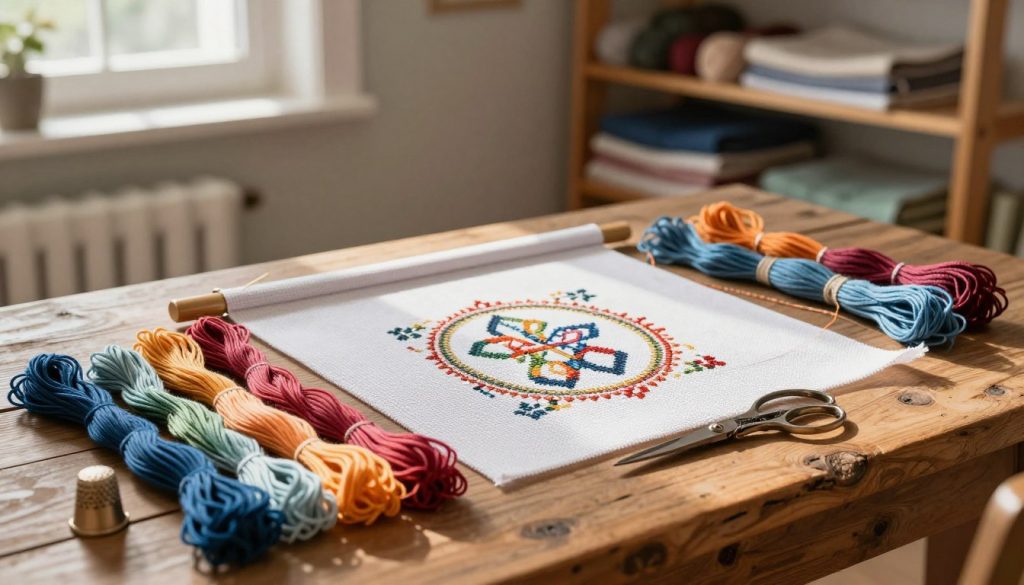
Begin with a small set of reliable tools to make stitching easier. Use blunt tapestry needles that fit your fabric count. Choose an embroidery hoop for small designs or a scroll frame for bigger ones.
Good cross stitch frames help keep your work even and protect your stitches. They make your work smoother.
Organize your DMC floss by number on bobbins or in a plastic organizer. Label each bundle so you can find colors fast. If your floss knots or splits, condition it by running it between your fingers or using a thread conditioner.
- Needle minder to keep your needle safe between sessions.
- Magnifier or task lamp to reduce eye strain during detailed areas.
- Thread organizers and bobbins to sort long color runs.
Mark your chart and fabric to track your progress. Make a photocopy of the pattern and highlight finished areas. This protects the original.
Grid your fabric to match 10-by-10 blocks on the chart. This makes counting easier and reduces mistakes. These needlework secrets help you stitch faster and with fewer errors.
Work by color blocks instead of following symbols. This reduces thread changes and saves time. Use a magnetic chart board or a page marker to follow rows without losing your place.
When you find a mistake, unpick only back to a stable point. Then, re-count before re-stitching. A seam ripper or a fine needle works well for careful removal. This keeps your finished piece neat.
Combine counted cross stitch with blackwork by following the chart’s symbols. Use two strands for cross stitch and one strand for blackwork unless the designer says otherwise. Trying mixed techniques can feel like cross stitch therapy when the pattern balances texture and contrast.
Practice simple cross stitch techniques to speed up recurring tasks. Use short lengths of DMC floss to avoid tangles. Switch to longer threads only for large, uninterrupted areas. Keep a small kit with your favorite cross stitch tools in one place so you can stitch whenever time allows.
Conclusion
Symbol charts are your guide for successful cross stitch. They help you read the grid and match symbols to threads. This turns a design into precise needlework.
Use center marks and 10-by-10 grid lines to place your design. This way, you can count with confidence.
Adopt habits to keep your work steady. Grid your fabric and organize floss with bobbins or a DMC thread box. Keep a consistent stitch direction.
Marking progress and using tools like hoops and frames helps. This reduces errors and speeds up your work. It’s good for beginners and advanced stitchers alike.
Combine these techniques with good floss care and clear chart reading. This makes your cross stitch projects fun. Whether you’re looking for new ideas or inspiration, following these methods showcases your skill and creativity.
FAQ
What are symbol charts and why are they the foundation of counted cross stitch?
How do charts translate a design into stitches?
Why does each grid square equal one stitch?
How do center marks and grid lines help you start in the middle?
What common elements appear on professional charts?
How do 10-by-10 darker grid blocks and line numbers help when reading a chart?
How do I use center arrows to align fabric and pattern correctly?
What happens if I rotate the chart or fabric incorrectly?
How do symbols map to DMC floss and other thread brands?
What’s the difference between color-block charts and black-and-white symbol charts?
Can I substitute thread brands or colors listed in the legend?
How do charts show full cross stitches versus other stitch types?
What are the common backstitching conventions on charts?
How are fractional stitches and French knots indicated on a chart?
What fabric and count should I choose for a pattern?
How many strands of floss should I use for different stitches?
How and why should I grid my fabric to match the chart?
What are common cross stitch mistakes when reading charts and how do I avoid them?
What essential tools should I have for chart-based cross stitch?
How should I care for DMC floss and other threads?
What needlework hacks speed progress and improve accuracy?
How can I combine counted cross stitch with blackwork in mixed charts?
Where can I find reliable guidance on charts, symbols, and techniques?
This post contains affiliate links. If you click on a link and make a purchase, I may earn a small commission — at no extra cost to you. Thank you for supporting this blog and helping me keep the patterns free! Read the full Affiliate Disclosure & Transparency.